But what is Japanese mythology, really?

There are so many mythologies around the world — Greek, Norse, Indian, and more.
An illustrated background showing colorful floating bubbles labeled “Norse Myths,” “Greek Myths,” “Hindu Myths,” “Hawaiian Myths,” and “Japanese Myths,” representing mythologies from around the world, with the phrase “and many others” at the bottom.

Japanese mythology is one of them.It’s been passed down by word of mouth since long before written history began. Sometimes, even when a country disappears, its myths remain to tell us what life was like back then.In many places, mythology exists apart from a nation’s recorded history.

But Japan is a little different — it actually has an official collection of myths, compiled by the government long ago.That’s the Kojiki, Japan’s oldest historical record, completed in 712 CE.

It has three volumes: the first tells the myths, and the rest are about people.Just like the myths of other cultures, the Kojiki is full of stories about deities — funny, powerful, and sometimes surprisingly human. It’s a lot of fun to read!
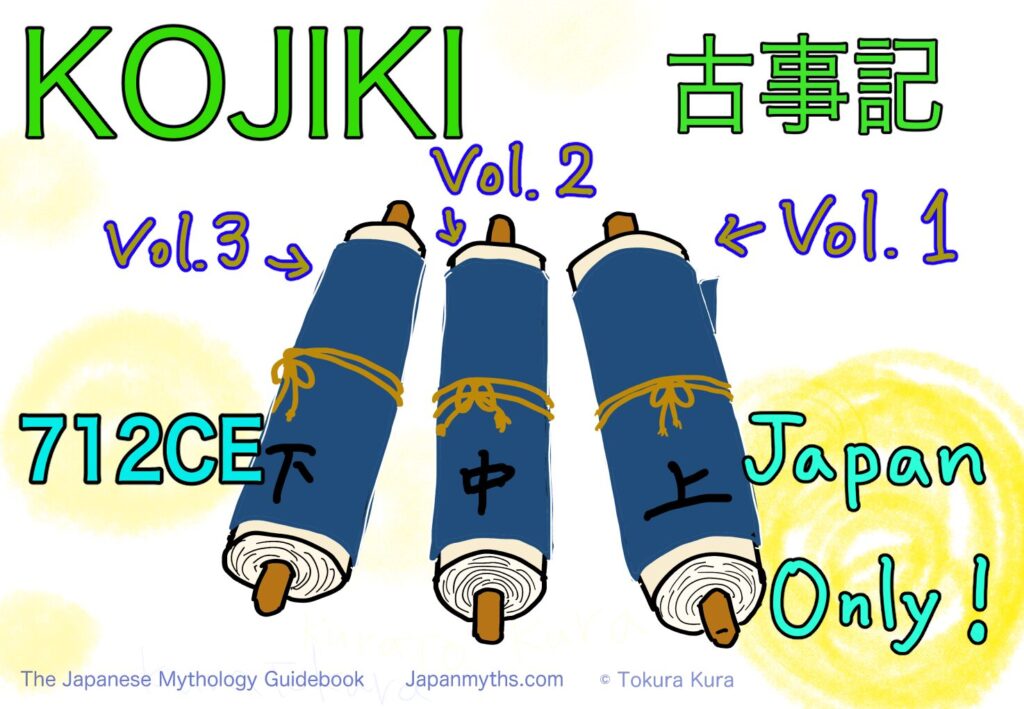
Illustration of three rolled scrolls representing the volumes of the Kojiki, the oldest Japanese chronicle. Each scroll is wrapped in a blue cover and tied with a cord, labeled as Vol. 1, Vol. 2, and Vol. 3 with arrows indicating their order. Large text reads “KOJIKI” and “Kojiki Vol. 2,” with additional text saying “Japan Only” and the catalog number “712CE.” The image promotes The Japanese Mythology Guidebook by JapanMyths.com, highlighting the Kojiki as a Japan-exclusive historical text.


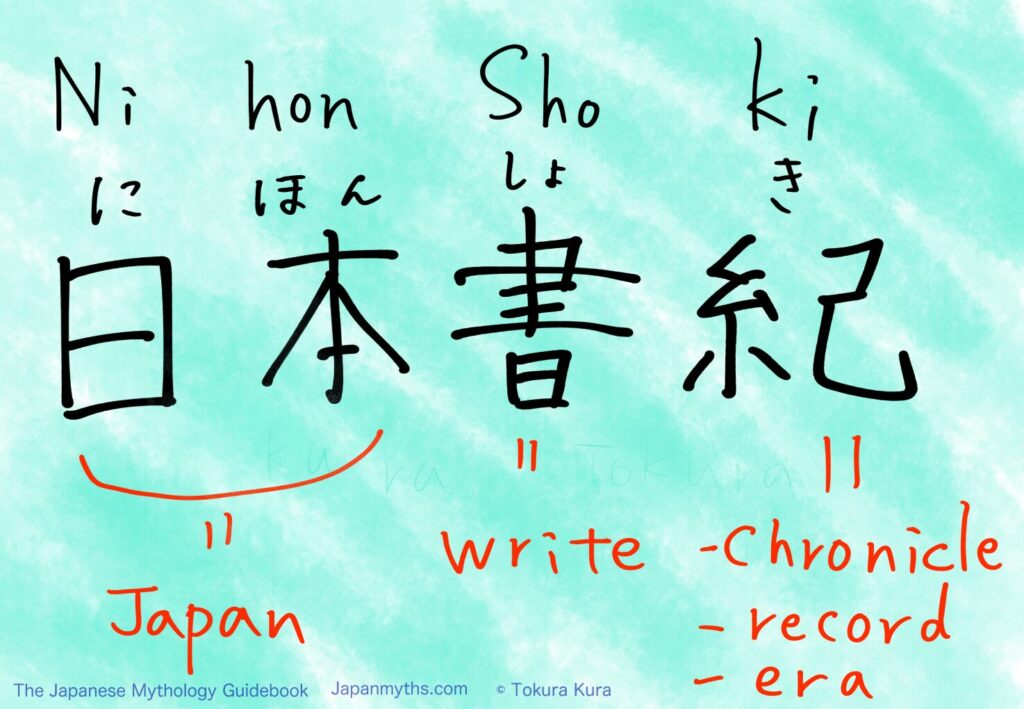
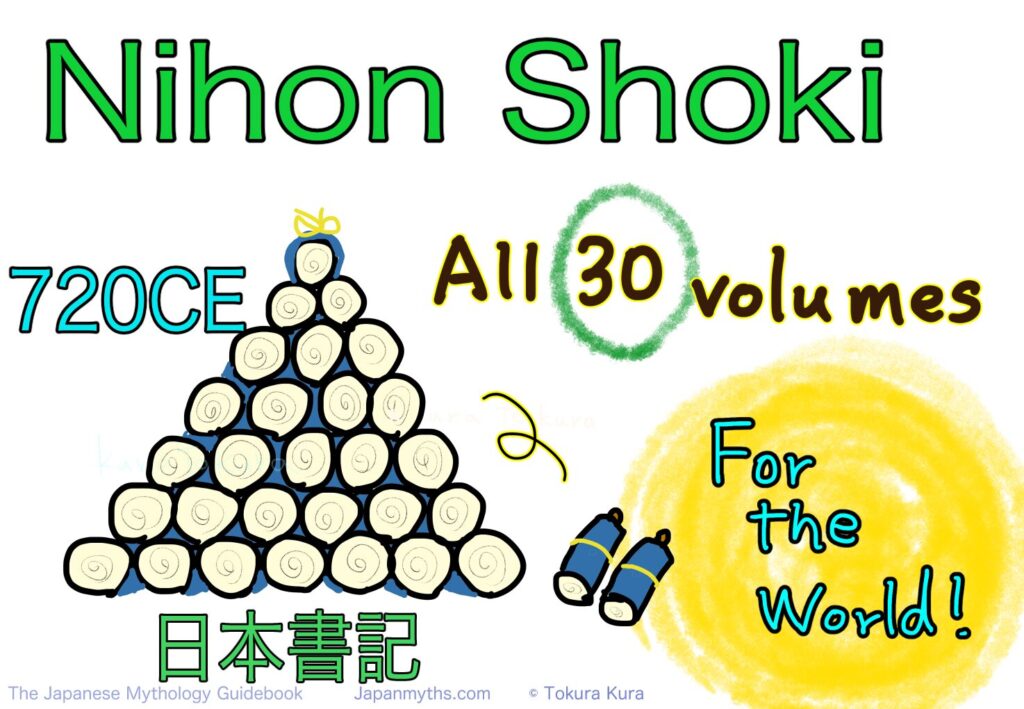
The Kojiki was written in Japanese, for people living in Japan.Around the same time, another book called the Nihon Shoki was also compiled. This one was meant for readers outside Japan. It was written in classical Chinese — which was the common written language across East Asia back then — and it has thirty volumes in total. The Nihon Shoki includes many of the same myths as the Kojiki, but the way it’s written is different.
The Kojiki tells the stories like a narrative, while the Nihon Shoki reads more like a historical record, showing different versions and viewpoints of each event.

So, in short:
Kojiki: written in Japanese, for people in Japan
Nihon Shoki: written in classical Chinese, for readers abroad

Overview of the Kojiki’s Three Volumes

1
The First Volume

Mythology The Age of the Deities

2
The Second Volume

The Age of Humans Begins From the First to the Fifteenth Emperor

3
The Third Volume

The Imperial Line Continues From the Sixteenth to the Thirty-Third Emperor

On this website, I adapt the mythological part of the first volume of the Kojiki into manga.

A colorful illustrated poster introducing Nihon Shoki (The Chronicles of Japan). At the top, large green text reads “Nihon Shoki.” On the left, a pyramid made of rolled scrolls represents the 720 CE compilation, with the scrolls stacked neatly in a triangular shape. On the right, handwritten-style text says “All 30 volumes,” with the number 30 circled in green. Nearby, two rolled scrolls fly toward a glowing yellow circle with the words “For the World!” written inside. At the bottom, Japanese text reads “日本書紀,” accompanied by the subtitle “The Japanese Mythology Guidebook” and the website name “japanmyths.com.” The overall illustration has a warm, friendly, hand-drawn style that presents the Nihon Shoki as a complete and accessible Japanese mythology work for a global audience.

Sorry if it’s a bit hard to read. I wrote it quickly, so let me add some clarification. ↓
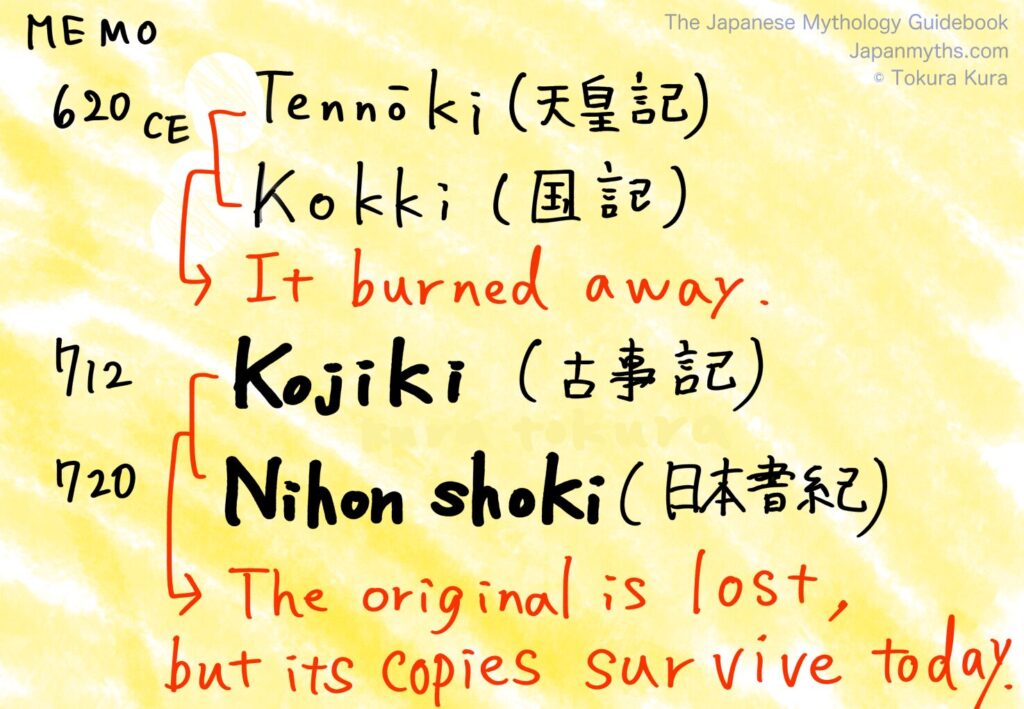
A handwritten-style timeline memo on a yellow background explaining early Japanese historical texts. It shows that Tennōki (天皇記) and Kokki (国記), compiled around 620 CE, were later lost when they burned away. Below, it lists Kojiki (712) and Nihon Shoki (720), noting that while the original manuscripts are lost, their copied versions have survived to the present day. The diagram uses red arrows and handwritten notes to show the historical flow.

Actually, there was an even older historical record before the Kojiki,
but for various reasons, it was lost in a fire.

Even the Japanese don’t really know when Japan became Japan.

Japan has been around since ancient times.
But it’s so old that no one knows the exact date it was founded. Even today, experts still disagree about when Japan actually began.
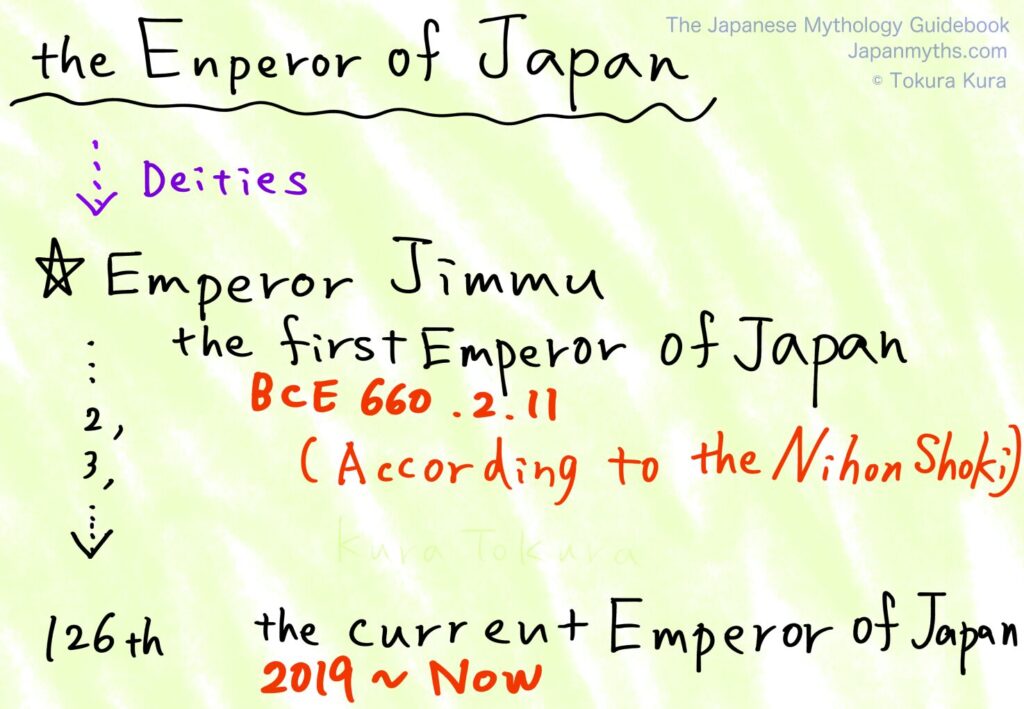
An illustrated chart titled “The Emperor of Japan,” explaining the imperial lineage in Japanese mythology and history. It shows that the line begins with deities, then highlights Emperor Jimmu as the first Emperor of Japan, traditionally dated to February 11, 660 BCE according to the Nihon Shoki. The chart continues downward to the present day, indicating the current Emperor as the 126th Emperor of Japan, reigning from 2019 to now. The background is soft green with handwritten-style text and arrows showing the passage of time.

According to the Nihon Shoki, there’s a theory that Japan was founded on the day when the first emperor took the throne.
If that’s true, Japan has been “Japan” since 660 BCE — which means it’s been around for over 2,600 years!

Some people believe Japan existed even before that, while others think the real founding must have happened much later.
Either way, Japan’s history goes back so far that it’s honestly impossible to know exactly when it began.

The stories of the deities that were passed down from those ancient, almost mysterious times are collected in the first volume of the Kojiki.Even when it was compiled in 712 CE, the book was already called Kojiki — which literally means “Record of Ancient Matters.”
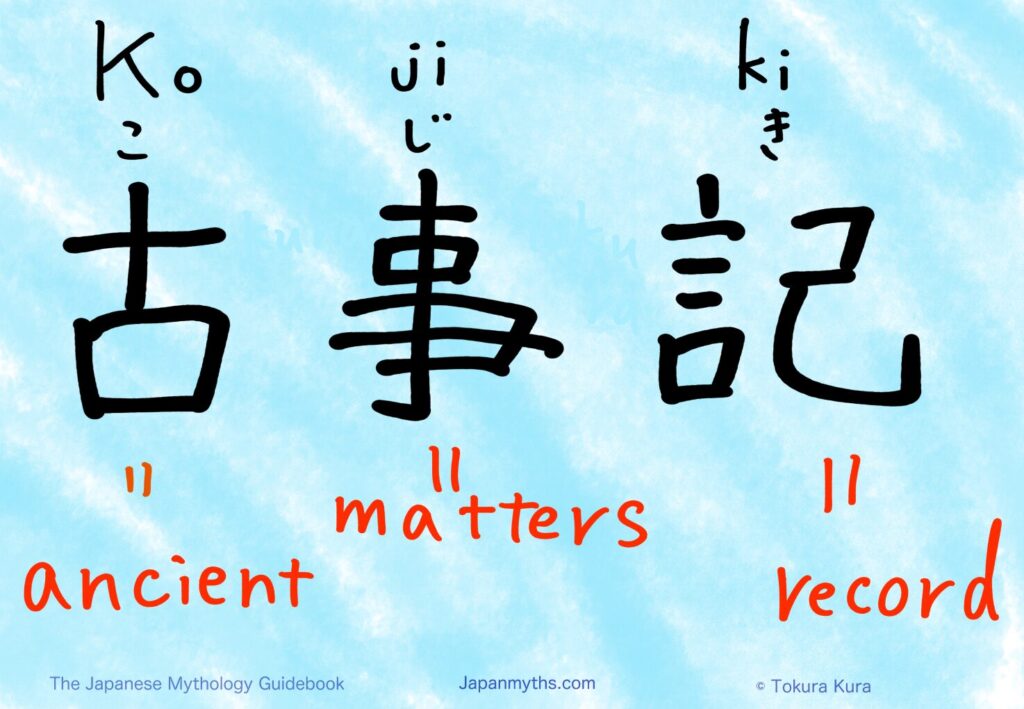
An illustrated explanation of the word “Kojiki” (古事記), breaking down its kanji: 古 (ko, ancient), 事 (ji, matters or events), and 記 (ki, record). The image shows handwritten-style kanji with pronunciation guides and English meanings against a soft blue sky background, introducing the Kojiki as an ancient Japanese record.
An illustrated explanation of the Japanese term “Nihon Shoki” (日本書紀). The kanji are shown with handwritten romaji and kana above them, explaining that “Nihon” means Japan and “Shoki” means to write, chronicle, record, or era. The background is a soft light blue, giving a calm and educational feel.

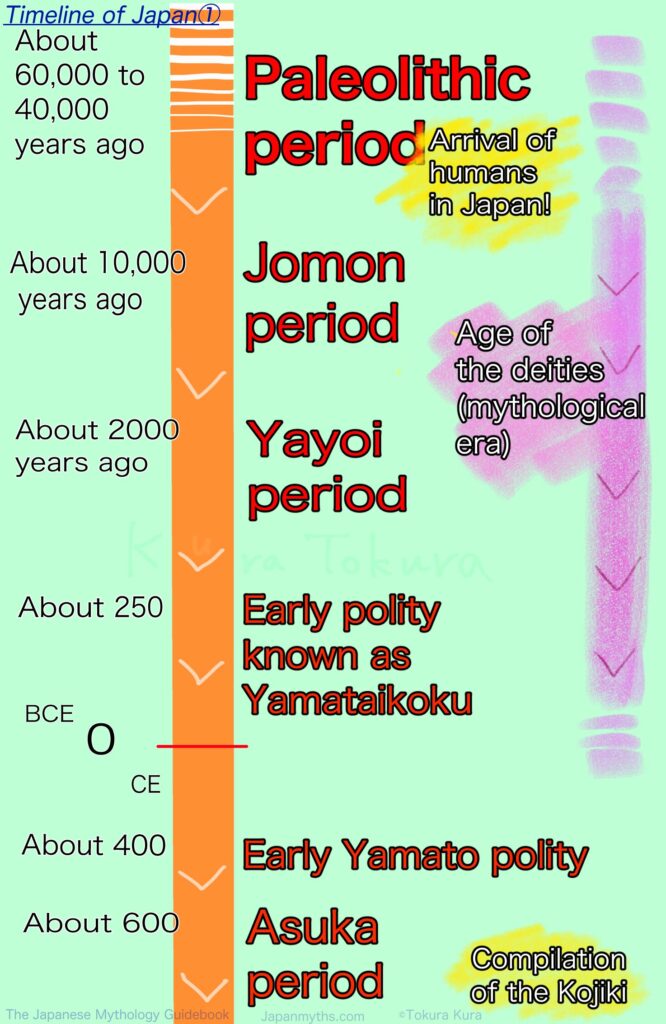
It’s a timeline of Japan!

A vertical timeline of Japanese history showing major periods from prehistoric times to the Asuka period. It begins with the Paleolithic period (about 60,000–40,000 years ago), marking the arrival of humans in Japan, followed by the Jomon period (about 10,000 years ago), described as the mythological “Age of the deities.” The timeline continues through the Yayoi period (about 2,000 years ago), the early polity known as Yamataikoku (around 250 CE), the early Yamato polity (around 400 CE), and the Asuka period (around 600 CE), noting the compilation of the Kojiki. The timeline includes BCE and CE markers and is presented in a simple, colorful infographic style.
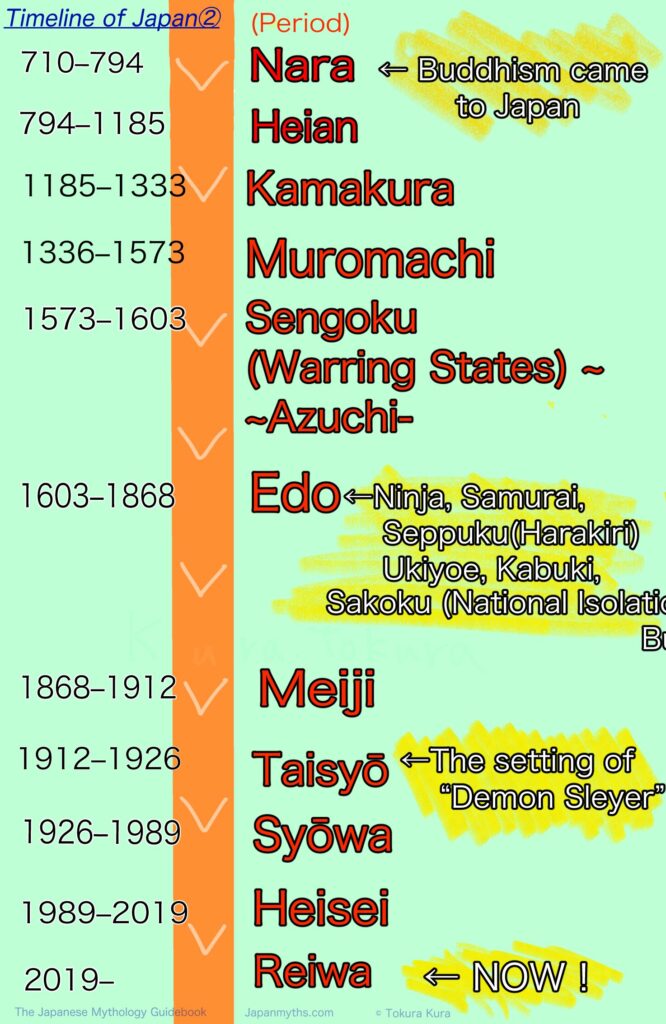
A colorful vertical timeline of Japanese history showing major historical periods with dates. It lists the Nara period (710–794), Heian (794–1185), Kamakura (1185–1333), Muromachi (1336–1573), Sengoku or Warring States period (1573–1603), Edo period (1603–1868) with notes such as samurai, ninja, seppuku, ukiyo-e, kabuki, and national isolation, followed by the Meiji (1868–1912), Taishō (1912–1926, noted as the setting of “Demon Slayer”), Shōwa (1926–1989), Heisei (1989–2019), and Reiwa period (2019–present). The timeline visually flows downward to represent the passage of time.

It seems that the deities of Japanese mythology were active around the purple section of the timeline.

Some people who are familiar with Japan might have thought that these myths came from the Edo period (1603–1868). That era was full of unique figures like ninjas and samurai, and many Japanese people are still big fans of it today.
Because Japan was closed off from the rest of the world at the time, its own distinct culture flourished.

If you know Japan even better, you might also be familiar with Yōkai.
Yōkai are supernatural creatures and ghost stories passed down among ordinary people.They share some similarities with mythology, but they’re actually quite different.

Tokura

This website explains the myths written in the Kojiki through manga.

Do Japanese people not know their own mythology?

We’ve talked a lot about the Kojiki so far, but in fact, not many Japanese people have actually read it.
Why? Because it’s not taught in schools.

Some people even say, “Kojiki? What’s that again?”On the other hand, there are also people who study Japanese mythology deeply—sometimes knowing even more than scholars!
Japanese mythology has inspired countless manga and anime.

So why not take a peek into its world yourself?

Japan has so many deities that you don’t need to remember them all!
Just read the manga and find your favorite one!

Support Here!

This is an independent project created by one person. 
If you enjoy it and want to support its growth, joining Patreon truly helps.
Created by a Japanese creator.

On Patreon, I share behind-the-scenes content from this project (paid).
• early access to high-resolution manga
• creation process & making-of videos
• character design stories
• deity-related locations

This project does not aim to promote or criticize any specific religion.
It is not intended to serve as an academic, historical, or educational reference.
Mythology is treated as a form of cultural narrative, and the material has been unofficially reorganized and reinterpreted for clarity.
The project places particular emphasis on carefully explaining concepts that may be difficult to understand, especially for readers unfamiliar with Japanese culture.