Japanese mythology is recorded in several ancient government documents.
The Kojiki and the Nihon Shoki are the most famous, but the following documents are also important sources for studying Japanese mythology.
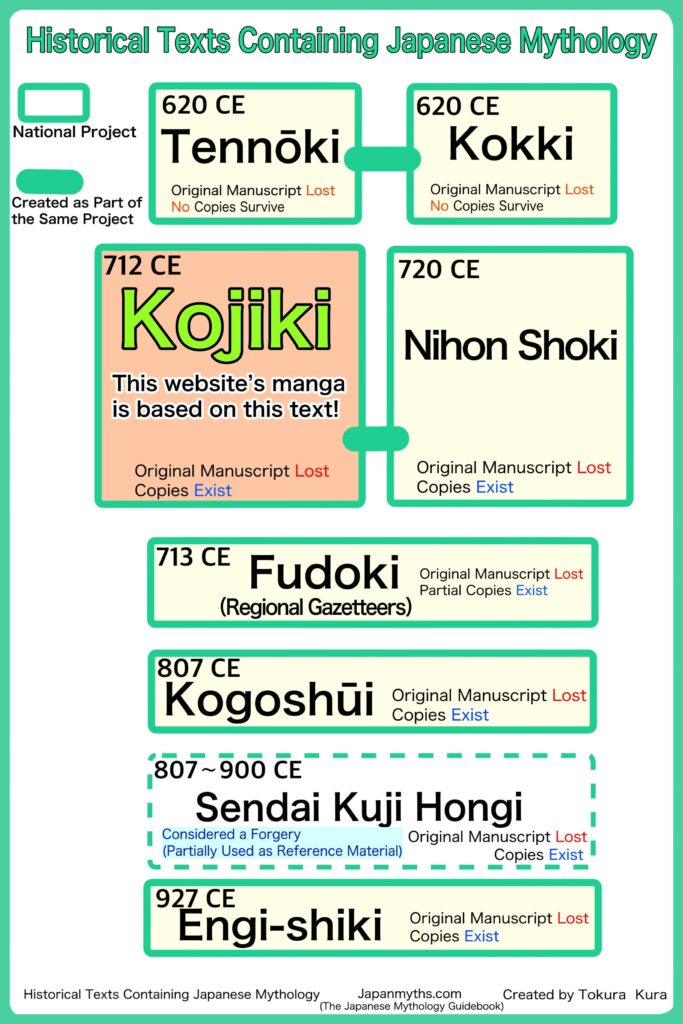
Tennōki
One of the oldest known historical texts of Japan, believed to have been compiled during the Asuka period.
It is traditionally said to have been connected to Prince Shōtoku and Soga no Umako, and is thought to have contained genealogies and records of the emperors.
However, it was reportedly lost during the Isshi Incident of 645, when the Soga clan’s residence was burned down.
No surviving copies exist today, and only its name is preserved in later historical records.
Kokki
A historical text said to have been compiled alongside the Tennōki.
It is believed to have recorded the origins of the nation, politics, and powerful clans.
Like the Tennōki, it was reportedly destroyed during the Isshi Incident and no longer survives today.
Only fragmentary information about it remains, and its full contents are unknown.
Kojiki
This website’s manga is based on this text.
The oldest surviving historical text in Japan, completed in 712 CE.
Commissioned by Emperor Tenmu, its contents were memorized by Hieda no Are and later written down by Ō no Yasumaro.
It describes the creation of the world, the stories of the Kami, and the genealogies of the emperors.
It is considered one of the most important sources for understanding Japanese mythology.
The original manuscript no longer exists, and only later handwritten copies survive.
Nihon Shoki
Japan’s oldest official historical chronicle, completed in 720 CE.
It was compiled under the direction of Prince Toneri and others.
Written in classical Chinese style inspired by Chinese dynastic histories, it was created as the official national history of Japan.
Compared to the Kojiki, it has a stronger political and diplomatic perspective, and often records multiple versions of the same traditions.
It covers events from Japanese mythology through the reign of Empress Jitō.
Fudoki
Regional gazetteers compiled for each province during the Nara period.
Their compilation began in 713 CE by order of Empress Genmei.
They record place-name origins, geography, local products, myths, and folklore.
These texts are valuable sources for understanding regional mythology and folk traditions.
Today, only the Izumo no Kuni Fudoki survives in nearly complete form.
Kogoshūi
A text written in 807 CE by Imbe no Hironari.
It was created to supplement rituals and traditions of the Kami that were not fully described in the Kojiki and Nihon Shoki.
One of its distinctive features is that it reflects the perspective of the Imbe clan, who were responsible for ancient rituals.
It remains an important source for the study of Shinto and ancient ceremonial practices.
Sendai Kuji Hongi
A historical text believed to have been compiled in the early Heian period.
While incorporating material from the Kojiki and Nihon Shoki, it also preserves many unique traditions.
It is especially notable for its extensive accounts related to the Mononobe clan, including myths not found in other texts.
However, the work has also been associated with later additions and theories of forgery, so it is studied carefully today.
For a long time, the text was traditionally believed to have been compiled by Prince Shōtoku and Soga no Umako.
Today, however, this theory is generally considered to be a later invention.
The actual compiler remains unknown, though it is thought likely that the work was assembled in the early Heian period by individuals connected to the Mononobe clan or sympathetic to its perspective.
In particular, the Tenson Hongi section contains detailed genealogies and traditions concerning the ancestors of the Mononobe clan, suggesting an intention to emphasize their authority and prestige.
The text also contains many passages adapted from the Kojiki and Nihon Shoki, and is therefore viewed less as a completely independent chronicle and more as a historical work reconstructed from earlier sources.
Engi-Shiki
A collection of detailed laws and ceremonial regulations compiled during the Heian period.
It was completed in 927 CE.
The text contains detailed rules regarding court rituals, government administration, and shrine ceremonies, providing valuable insight into the workings of the ancient Japanese state.
One of its most famous sections is the Jinmyōchō, a register of shrines officially recognized by the imperial court at the time.