Susanō Goes to Takamagahara
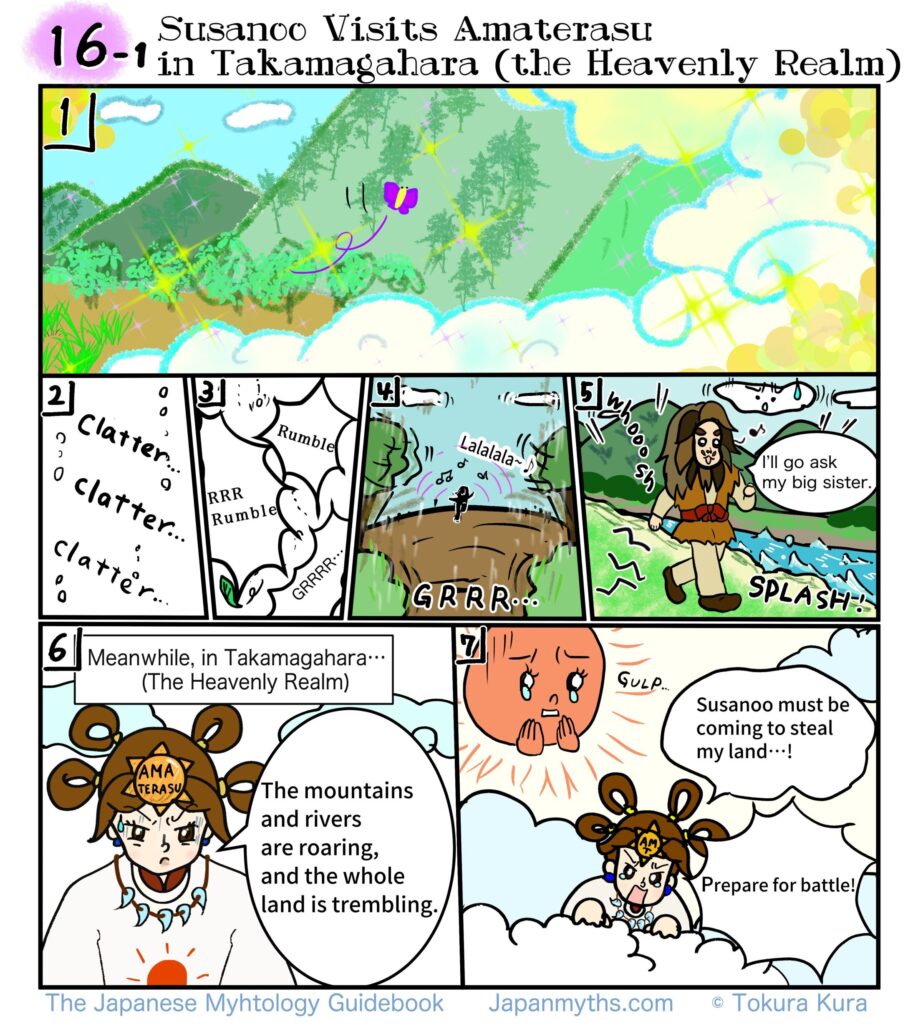
Susanō travels to Takamagahara, the Heavenly Realm where his older sister, Amaterasu, lives. He wants to ask for permission to leave for Ne-no-Katasu-kuni.
As Susanō approaches the heavens, the mountains and rivers begin to roar, and the entire land trembles.
Amaterasu is alarmed and thinks,
“My younger brother has not come here with good intentions. He must be planning to take my land.”
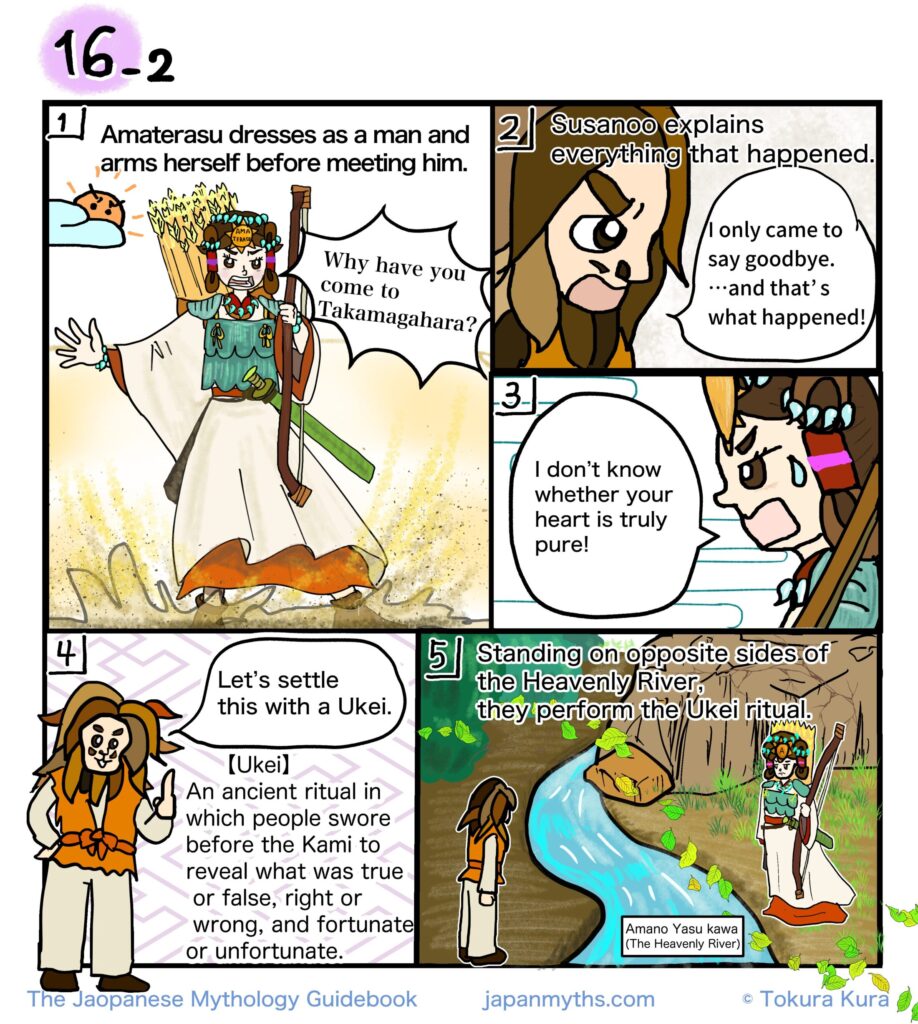
Amaterasu Arms Herself
Amaterasu prepares for battle by dressing like a man. She ties her hair in a masculine style and adorns her head, hair, and both arms with jeweled necklaces. She carries a quiver holding one thousand arrows on her back and another holding five hundred arrows at her side. She fastens a bamboo arm guard, raises her bow, stamps both feet firmly into the hard ground, scattering the earth like snow, and lets out a fierce cry like a mighty warrior.
Then she demands,
“Why have you come to Takamagahara?”
Susanō explains everything that has happened. He tells her that he wept because he wanted to see their late mother, that he wished to go to Ne-no-Katasu-kuni, and that their father, Izanaki, had banished him from the land of the Kami.
Even after hearing his story, Amaterasu remains suspicious. She says that he must prove his heart is pure.
Susanō proposes an Ukei.
“Let us perform an Ukei together and bear children.”
What Is an Ukei?
Ukei was an ancient Japanese ritual used to determine whether a person’s words or intentions were true.
Before the ritual, each person made a vow before the Kami, declaring a condition such as, “If this happens as a result of the ritual, it will prove that I am innocent.” The outcome of the ritual was then accepted as the Kami’s judgment, revealing whether a person was truthful or deceitful, or whether the omen was fortunate or unfortunate.
This version of Amaterasu actually makes me a little worried.
She’s carrying 1,500 arrows, wearing armor, and covered in magatama ornaments. Add a bow and a sword on top of that… it all has to be incredibly heavy.
Honestly, it feels like she has too much equipment. I can’t imagine she could move very well like that. Maybe looking strong was more important than being able to move freely.
As the story goes on, Amaterasu eventually has a mental breakdown and shuts herself away. Looking back, I can’t help but wonder if the signs were already there.
Sometimes, when we’re afraid, we try to protect ourselves by taking on more and more. But instead of making us stronger, those extra burdens can end up weighing us down.
Amaterasu seems like the kind of person who carries everything on her own instead of asking others for help. In the end, she withdraws from the world.
Maybe this chapter was quietly hinting at what was waiting for her all along.