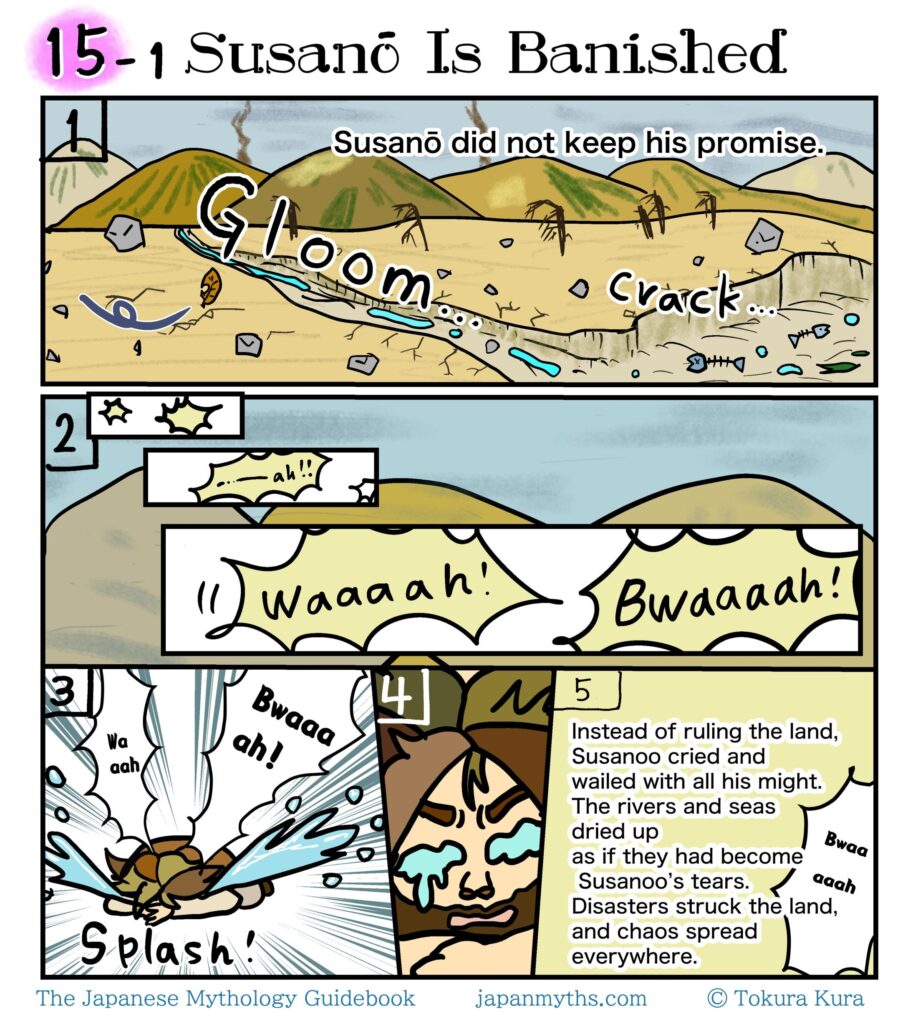
A manga page from The Japanese Mythology Guidebook titled “15-1 Susanoō Is Banished.” The first panel shows a barren landscape with dried rivers, cracked ground, dead trees, scattered rocks, and fish skeletons, illustrating the devastation caused by Susanoō’s actions. The narration explains that Susanoō did not keep his promise. The following panels show him crying loudly, with exaggerated comic sound effects. His endless tears are portrayed as overwhelming waterfalls, while the narration explains that instead of ruling the land, Susanoō cried and wailed continuously. The rivers and seas dried up as though they had become his tears, bringing disasters and chaos across the land. The page presents a dramatic yet humorous interpretation of the Japanese mythology story from the Kojiki.
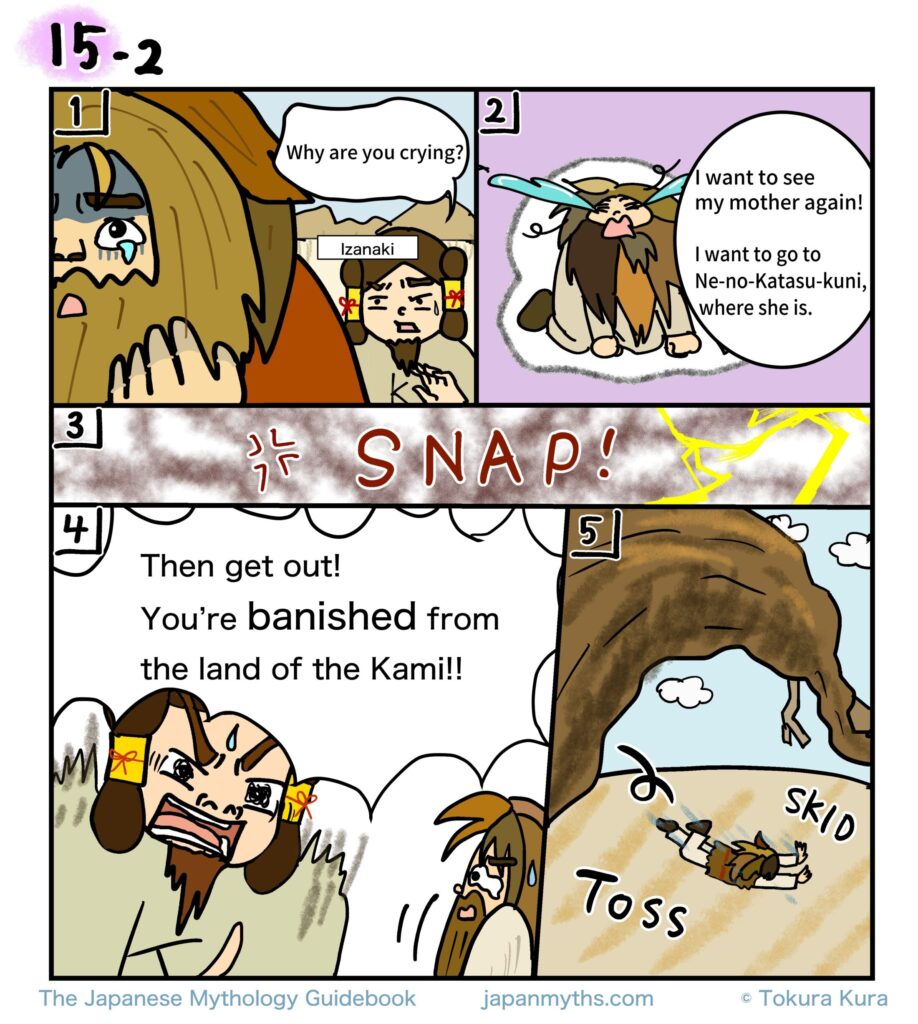
A manga page from The Japanese Mythology Guidebook continuing the story of Susanoō from Japanese mythology. Izanaki asks Susanoō why he is crying. Susanoō tearfully replies that he wants to see his deceased mother again and wishes to travel to Ne-no-Katasu-kuni, the land where she resides. Angered by this answer, Izanaki snaps and angrily banishes Susanoō from the land of the Kami. In the final panel, Susanoō is dramatically tossed away, sliding across the ground in a humorous manga-style scene. The page depicts the moment when Susanoō is exiled from Takamagahara, marking a major turning point in the Kojiki narrative while balancing emotional storytelling with comedic expressions.

🟣Susanō Refuses to Rule the Land

Susanō, who had been assigned to rule the seas, did not obey his father Izanaki’s command. Instead, he cried endlessly. His tears became the rivers and seas, drying them up completely. His beard grew so long that it reached his chest.
When Izanaki asked why he was crying, Susanō replied, “I want to see my dead mother. I want to go to Ne-no-Katasu-kuni, where she is.”
Hearing this, Izanaki became furious and banished Susanō from the land of the Kami.
Tokura

Who Is Susanō’s “Mother”?

Susanō was born from Izanaki’s nose. Yet he says that he wants to go to Ne-no-Katasu-kuni to see his dead mother, which seems contradictory.

The reason becomes clearer in the Nihon Shoki. Unlike the Kojiki, it states that Susanō’s mother is Izanami. In the Kojiki, Izanami resides in Yomi, the land of the dead. The Nihon Shoki also says that she went to Yomi after her death.
So where is Ne-no-Katasu-kuni, the place mentioned in this story?

Unfortunately, very little is known about it. Beyond being described as an underground realm, its exact nature remains a mystery.

The relationship between Susanō and Izanami is portrayed differently in the Kojiki and the Nihon Shoki.
I hope to explore these differences in more detail someday.

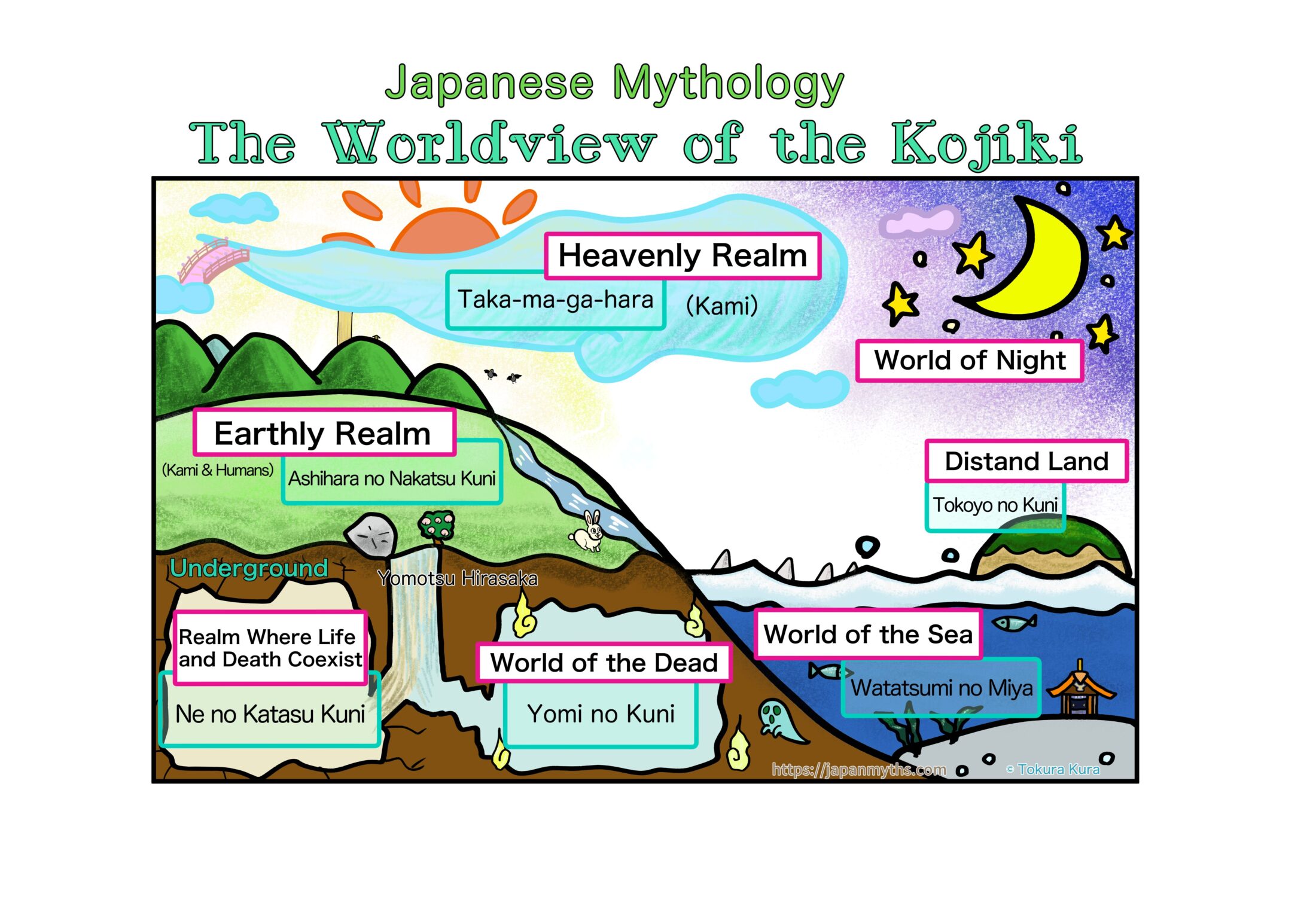
For reference, I’ve included a diagram of the world described in the Kojiki below.

An illustrated diagram titled “Japanese Mythology: The Worldview of the Kojiki.” The image explains the major realms in the world of Japanese mythology. At the top is the Heavenly Realm, labeled Taka-ma-ga-hara, the realm of the Kami. Below it is the Earthly Realm, labeled Ashihara no Nakatsu Kuni, where Kami and humans live. On the right is the World of Night, shown with a moon and stars, and a small island labeled Distant Land: Tokoyo no Kuni. At the bottom right is the World of the Sea, labeled Watatsumi no Miya. Underground, two mysterious realms are shown: Ne no Katasu Kuni, described as a realm where life and death coexist, and Yomi no Kuni, the world of the dead. The diagram also includes Yomotsu Hirasaka, the slope that connects the earthly realm to Yomi.